
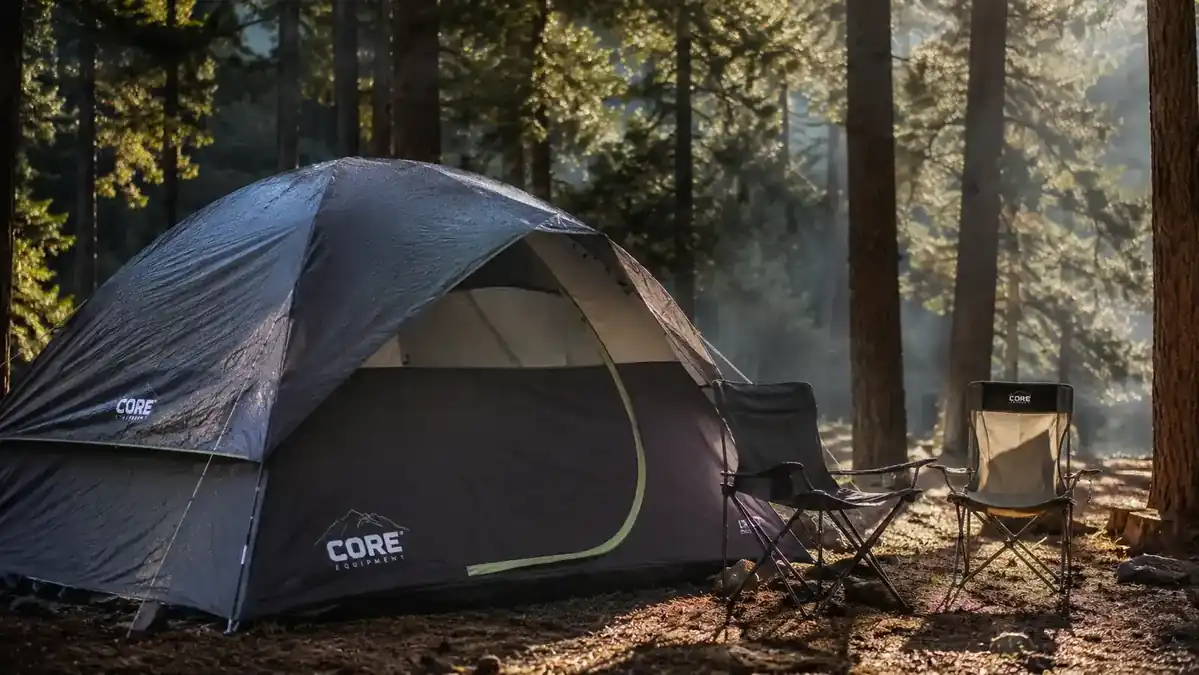
Short answer: if you're buying one tent for car camping and you want it to last more than two seasons, buy the CORE. The Coleman Sundome 6-person is a fine tent at a lower price, but it cuts corners on weather protection and pole durability in ways you'll notice the first time you camp in real weather. I've set up both on real trips, and this comparison comes from actual use, not spec sheets.
That said, the Coleman Sundome 6-person is not a bad tent. If your budget is tight and you're camping on mild summer weekends in a campground with electrical hookups and a picnic table, it'll work. The question is what you're actually getting for the price difference, and whether those trade-offs matter on the trips you're planning.
| CORE Dome Tent | Coleman Sundome 6-Person | |
|---|---|---|
| Floor Area | 100 sq ft | 100 sq ft |
| Peak Height | 72 inches (6 ft center height) | 64 inches (5 ft 4 in center height) |
| Rainfly Coverage | Full fly, covers all vents and windows | Partial fly, leaves lower mesh panels exposed |
| Pole Material | Fiberglass-reinforced composite | Fiberglass (thinner gauge) |
| Hydrostatic Head Rating | 1200mm (seams factory-taped) | Not rated; seams not taped |
| Setup Time (2 adults) | 10-12 minutes first pitch | 15-20 minutes first pitch |
| Weight | Approx. 17 lbs packed | Approx. 18 lbs packed |
| Carry Bag Quality | Reinforced bag, fits easily post-trip | Undersized bag, hard to repack wet |
| Current Price Range | Mid-range on Amazon | Mid-range on Amazon |
Where the CORE Dome Tent Wins
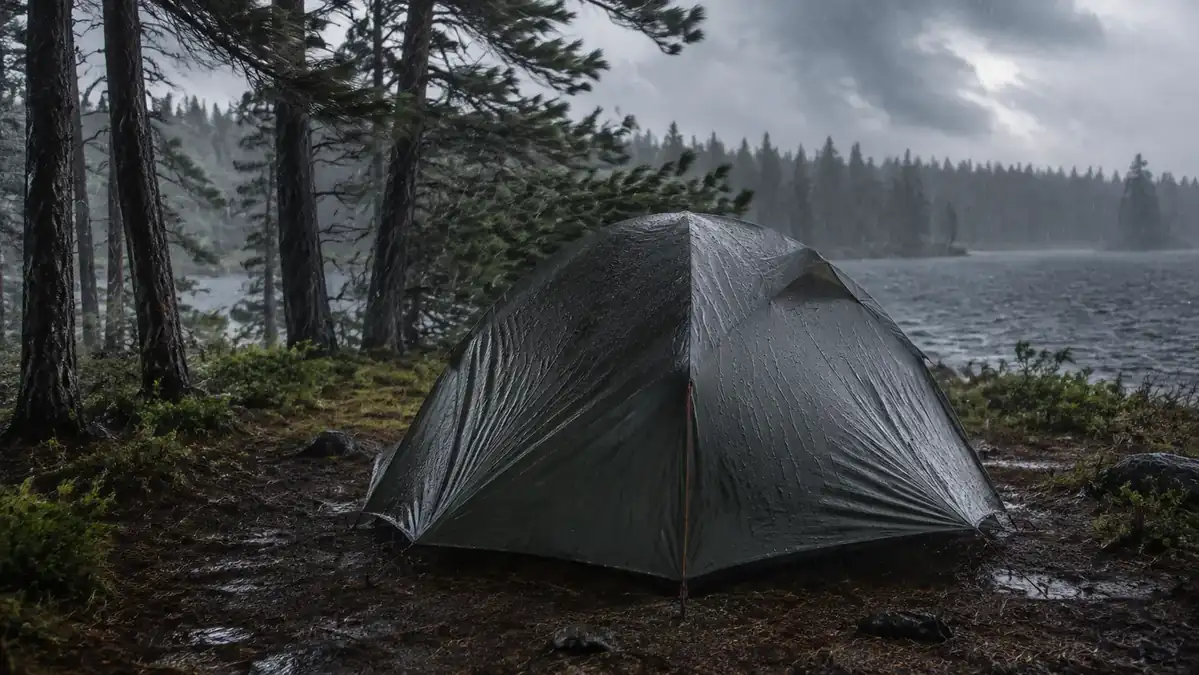
The single biggest advantage the CORE has over the Coleman Sundome is the rainfly. The CORE uses a full-coverage fly that comes down close to the ground on all sides and covers the vestibule area. The Coleman Sundome's partial fly leaves the lower mesh panels exposed. In a light shower, that doesn't matter. In a real storm with wind-driven rain, you'll wake up with wet gear on the side facing the wind. I've camped in both, and I've learned this lesson the hard way in an old Sundome at a campsite in the Ozarks during a pop-up thunderstorm in August. The CORE didn't have that problem.
The head room difference is real and underrated. Eight extra inches of peak height sounds minor until four people are changing clothes inside on a cold morning. At 6 feet of center height, the CORE lets a normal-sized adult stand almost fully upright. The Coleman tops out at 5 feet 4 inches, which means most adults are crouched the whole time they're inside doing anything other than sleeping. If you're camping with kids, neither of you will notice. If you're camping with adults, you will notice by the end of the first night.
The CORE's hydrostatic head rating and seam-taping also matter when you're camping on a slope and groundwater is pooling under the tent. The Coleman has no published water resistance rating on the floor, and the seams are not factory-sealed. If you stake it out on a flat site in dry weather, that's fine. If you're in a campground where you get whatever site is left, having a properly sealed floor is the kind of thing you appreciate at 2 a.m. in a rainstorm. For a deeper look at how the CORE performs over multiple seasons, see our long-term CORE dome tent review.
Where the Coleman Sundome Wins
Price is the obvious one. The Coleman Sundome 6-person typically comes in cheaper than the CORE, and for someone camping two or three weekends a year in good weather at a managed campground, that difference is real money for a marginal upgrade. Coleman also has broader retail distribution, so if you're buying last-minute before a trip and need something at a physical store, you're more likely to find the Sundome in stock.
The Coleman also has a slight edge in interior layout. The Sundome's door placement and E-port (the cable port for running extension cords from a campground hookup) make it a little more car-camper friendly out of the box. If you're at an RV-style campground and you want to run a fan or charge devices from a power pedestal, that's a real convenience. The CORE doesn't have an E-port on the base model. For most of the camping I do, that's a minor point, but if you're doing campgrounds with hookups and you want that feature, Coleman has it.
Ready to stop waking up damp? The CORE gives you full-coverage weather protection at a price most campers can swing.
Over 4,400 campers have rated it 4.6 out of 5 stars. Check current availability and today's price on Amazon before your next trip.
Amazon Check Today's Price on Amazon →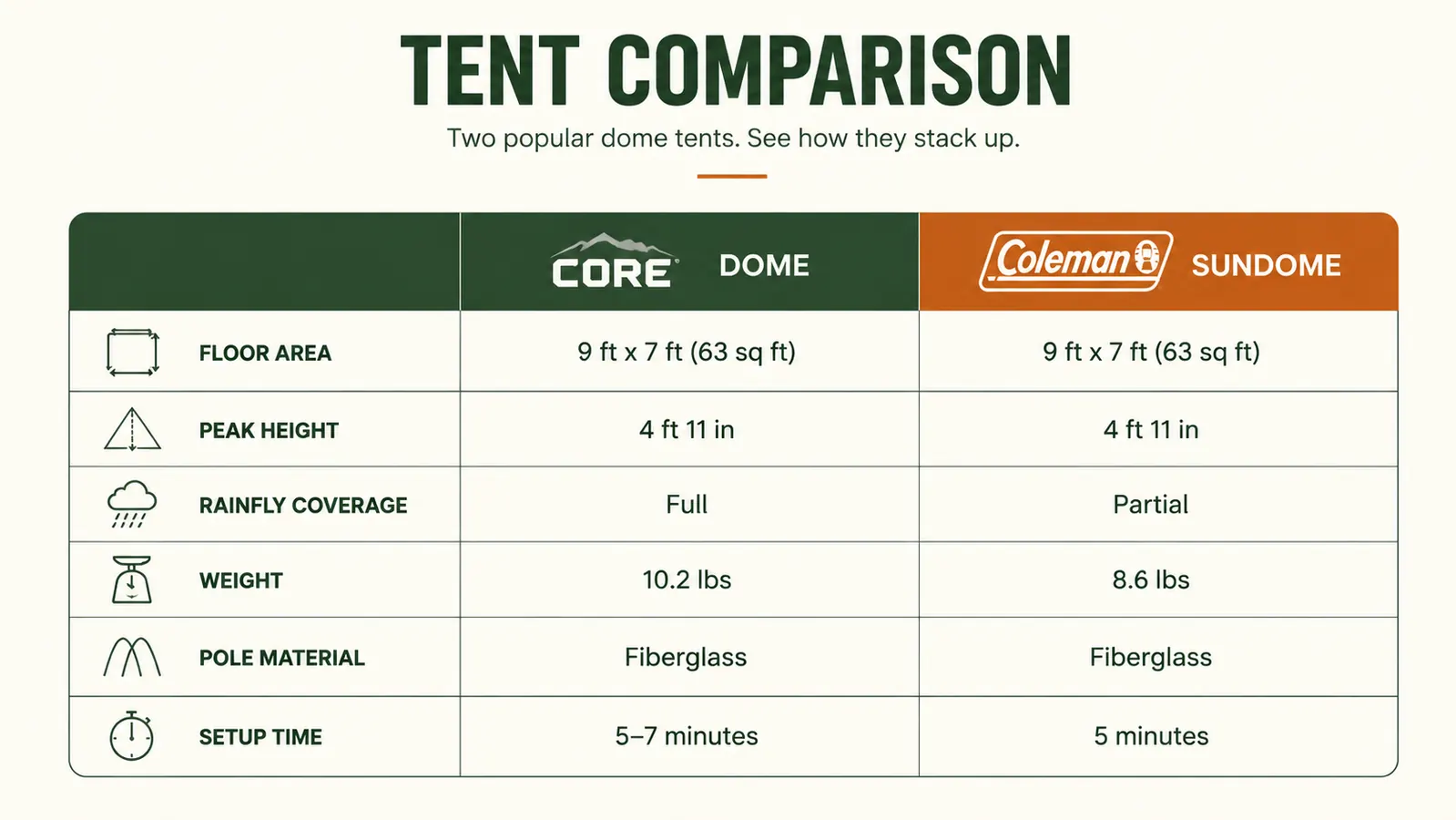
Setup: Which Tent Actually Goes Up Faster?
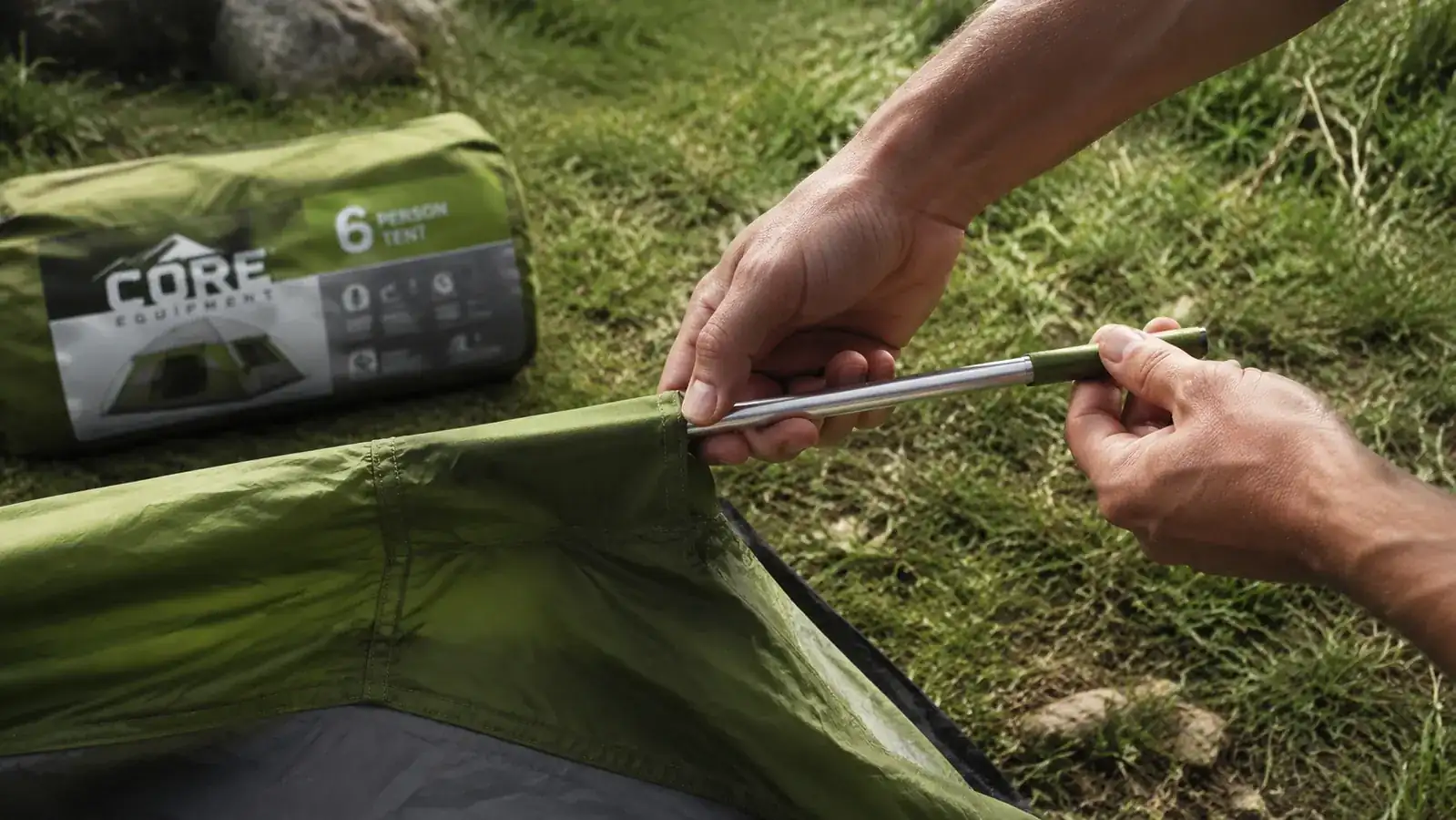
Both tents use a freestanding dome design with color-coded poles, so the basic process is the same. You connect the pole sections, thread them through the sleeve channels on the fly, and clip the tent body to the pole structure. Neither tent requires any special tools or reading the instructions twice. That said, the CORE's pole system is slightly more intuitive because the sleeves are clearly marked and the pole tension is tuned so the tent pops into shape without fighting you. First pitch on the CORE took my wife and me about 11 minutes at our campsite in Missouri. The Coleman Sundome took closer to 18 minutes the first time, mostly because the fly attachment points are less obvious.
Where the CORE really pulls ahead on setup is solo pitching. If you're camping alone or your camping partner stays in the car while you set up, the CORE's dome structure holds its shape better while you move around it. The Coleman has a tendency to collapse on the windward side if you don't stake it out early, which makes a two-person job out of something that should be manageable alone. If you want a step-by-step process for pitching either of these tents solo, see our guide on how to set up a camping tent solo and fast.
The first time you camp in actual wind and rain, you'll know exactly which tent you should have bought. The CORE's full fly is the difference between a good story and a miserable night.
Durability Over Multiple Seasons
Fiberglass poles are the weak point of both tents, and I won't pretend otherwise. Neither of these is a four-season mountaineering shelter with DAC aluminum poles. What separates them is pole gauge and sleeve quality. The CORE uses a slightly thicker composite pole and the sleeves are reinforced at the stress points where the poles bend over the dome. The Coleman's poles are thinner and the sleeves show wear faster, particularly at the corners. After two full seasons of weekend car camping, the CORE still looks and functions like a new tent. The Sundome models I've seen after a couple of seasons tend to show fraying at the pole tips and zipper wear faster than the CORE.
The zippers are also worth mentioning. Both tents use nylon coil zippers, but the CORE's are heavier gauge and have larger pull tabs. On a cold morning when you're wearing gloves and trying to get out to make coffee, that small detail matters. The Coleman's smaller pull tabs are a minor annoyance in warm weather and a real frustration in cold weather. It's not a dealbreaker, but it's the kind of thing that builds up over a trip.
Who Should Buy the CORE Dome Tent
Buy the CORE if you're camping in anything other than guaranteed dry weather, if you camp more than three weekends a year, or if you've ever woken up wet in a tent and swore you'd do better next time. It's also the right call if you have adults camping with you who will appreciate being able to stand up inside. The CORE is the tent I'd recommend to anyone who asks me what to get for family car camping without a lot of caveats attached. For a full breakdown of everything I've noticed after extended use, including what I'd change if I could, see our honest CORE dome tent review.
Who Should Buy the Coleman Sundome
Buy the Coleman Sundome 6-person if you're on a tight budget, you're camping exclusively in fair-weather summer conditions at established campgrounds, and you want a powered campsite with the E-port convenience. It's also a reasonable choice if you camp infrequently enough that the tent will never see a real storm. If that's your situation, you'll probably be happy with the Coleman, and there's no shame in matching your gear to your actual use case. Just know what you're trading away. And if you want to understand exactly what separates a dome tent from a cabin tent for different trip types, our article on 10 reasons a dome tent beats a cabin tent breaks that down in detail.
The CORE dome tent holds up in wind and rain and sets up in under 12 minutes. For most car campers, that settles the argument.
Rated 4.6 stars by 4,400+ buyers. Check if it's in stock and see today's price on Amazon before the next sale ends.
Amazon Check Today's Price on Amazon →