
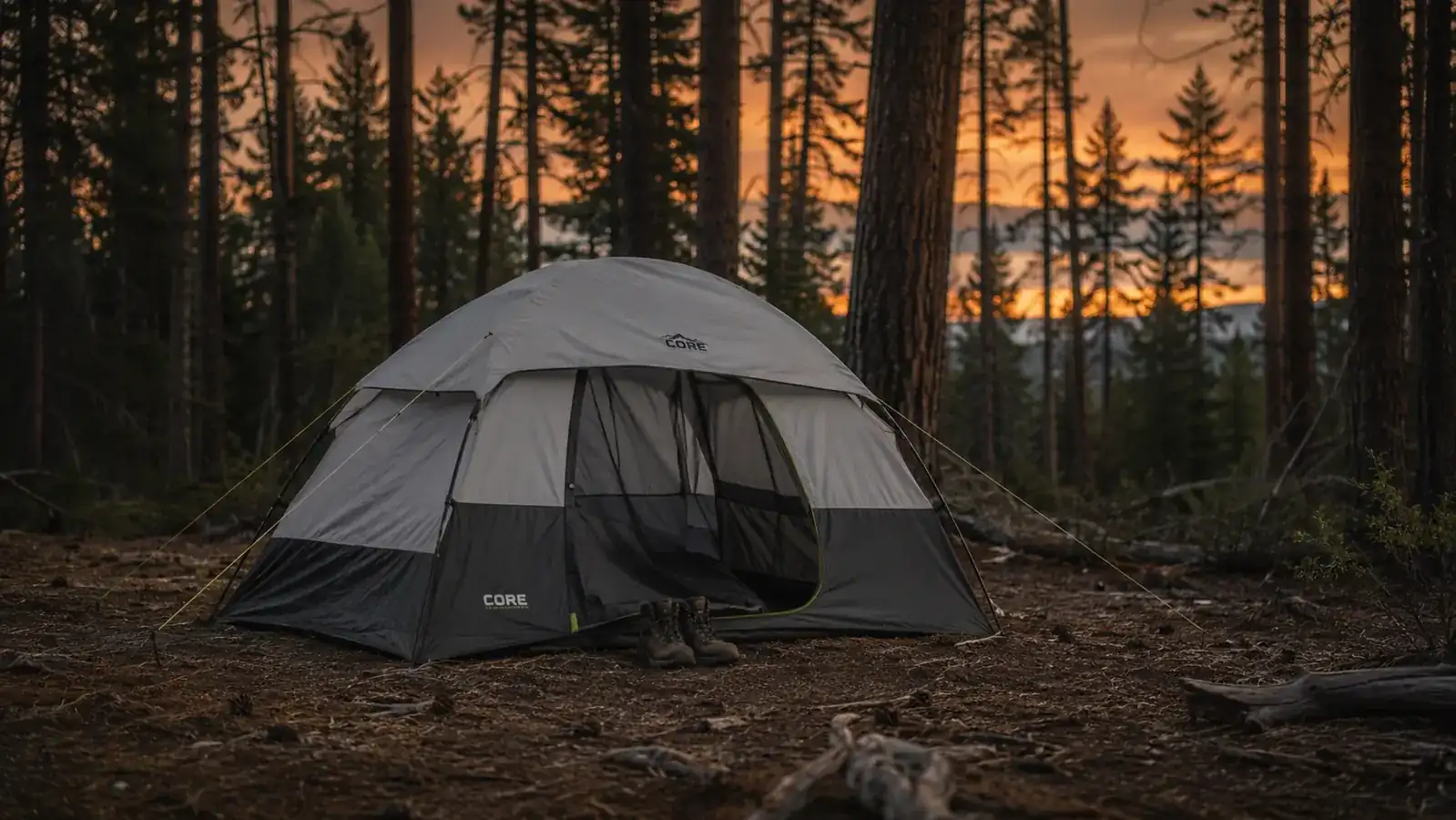
I set up the CORE Dome Tent for the first time at 10 pm on a Friday night in October, headlamp on, 38 degrees, hunting camp in the White Mountains of New Hampshire. Not exactly ideal testing conditions. By the time my buddy and I had it pitched and gear stowed, I had a working opinion on three things: the pole system, the stake quality, and whether the instructions were worth the paper they were printed on. Two were fine. One was not.
This isn't a family-camping puff piece. If you want the 18-month family camping angle on this same tent, read the long-term CORE tent review. What I'm going to tell you here is what hunters, hikers, and people who camp solo or in pairs actually need to know: where this tent punches above its price, where it cuts corners, and what I'd do differently the second time around.
The Quick Verdict
A legitimately capable budget dome tent that handles rain well and sets up fast once you've done it twice -- but the included stakes are junk, the ventilation requires active management, and it's not built for sustained high-wind camping.
Amazon Check Today's Price →If you camp more than twice a year, this tent is worth every dollar at this price.
The CORE Dome Tent runs in the budget range on Amazon. It's Buy Box verified, ships fast, and at 4.6 stars across nearly 4,500 reviews, it's about as close to a proven budget pick as you'll find. Check the current price before it moves.
Amazon Check Today's Price on Amazon →How I've Used It (Not How the Photos Show It)
I've put the CORE through five distinct trips over the past year: two hunting base camps in northern New England, one three-day solo hike in the Adirondacks, one car-camping weekend with my wife in the Catskills, and one last-minute overnight during a fishing trip in Vermont that turned into a surprise thunderstorm. That last one was probably the most useful test of all.
The tent is marketed as a 4-6 person shelter. I used it as a 2-person tent on every trip except the solo hike, and that's probably the sweet spot. Two adults with their packs inside is comfortable. Three would work if you're friendly. The 86-square-foot floor feels honest, not inflated the way some budget tents measure their footprint. For context, a standard king bed is about 42 square feet -- 86 square feet for a dome tent is genuinely usable, not just a number on a spec sheet.
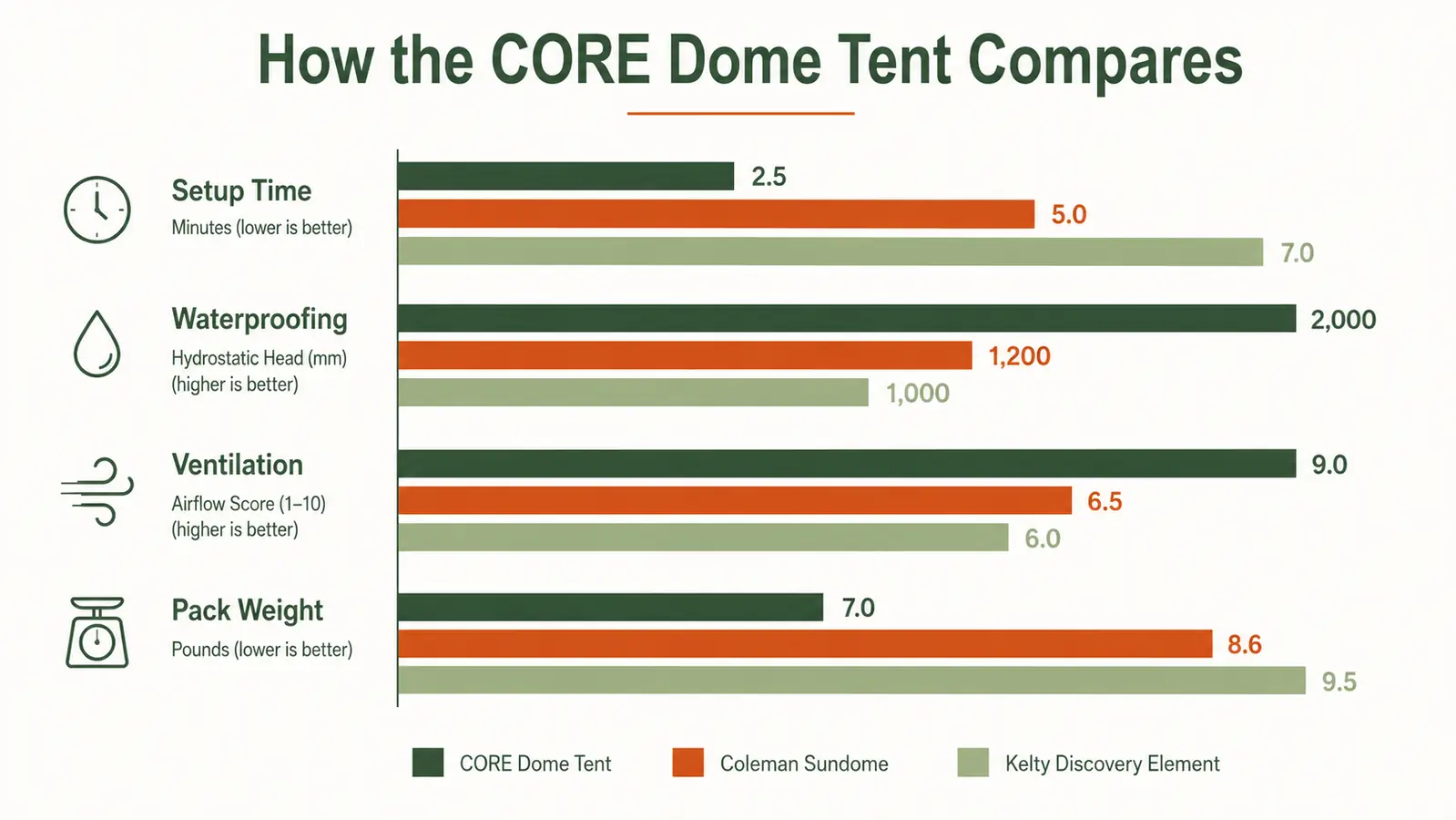
Setup took me about 25 minutes the first time, which is slow. The instructions assume daylight and calm conditions and offer minimal guidance on pole order. By trip three I had it down to around 12 minutes solo, which is reasonable for a freestanding dome with a separate rainfly. If you want a faster system, read the guide on how to set up a camping tent solo and fast, because the technique matters as much as the gear. Threading the poles before staking anything is the single biggest time-saver I found.
What the Marketing Photos Hide: Four Things Nobody Mentions
The CORE tent looks great in its listing photos. Clean campsite, sunny afternoon, family smiling. Here's what the photos don't show you.
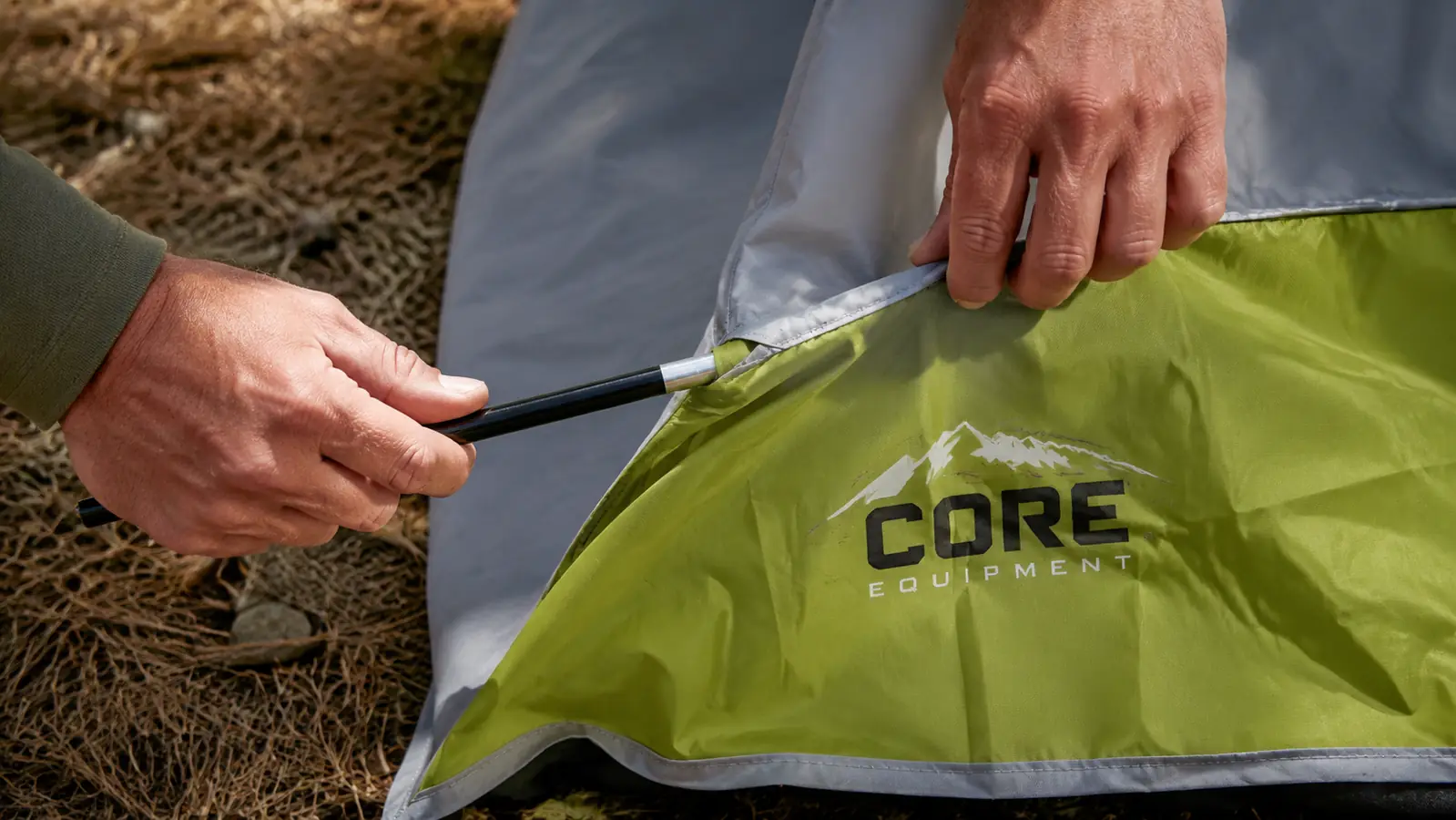
First, the included stakes are nearly useless. They're thin wire stakes that bend on contact with anything harder than packed dirt. I snapped one staking into compacted gravel on my second night at hunting camp. Bring your own 6-inch aluminum shepherd's-hook stakes or titanium skewers if you're going somewhere with real ground. Budget another modest amount for stakes and consider it part of the tent's true cost.
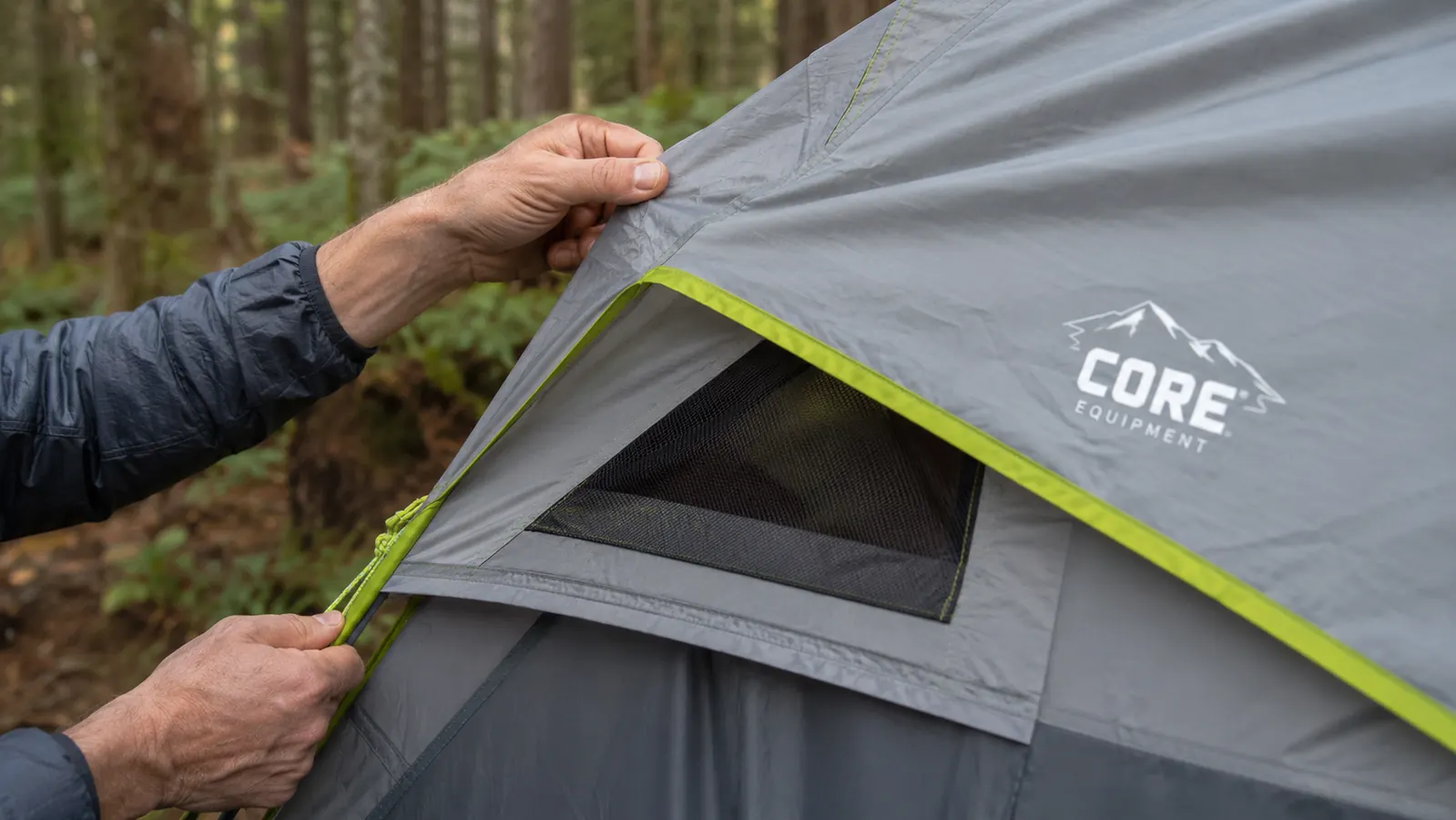
Second, the rainfly doesn't cover the mesh vent panel above the main door. There's a gap, probably 6 to 8 inches, between the bottom of the rainfly and the top of the door's mesh vent. In a light rain at an angle, water doesn't get in. In a heavy horizontal rain, it can. During my Vermont thunderstorm overnight, I woke up to a strip of wet sleeping bag on my buddy's side, closest to that door. It wasn't catastrophic, but it was real. The fix is to position the door away from the wind direction before you stake the tent, not after. Orient your door to face downwind and you eliminate this problem almost entirely.
Third, the fiberglass poles are fine for car camping and most 3-season use, but they flex noticeably in sustained wind above 35 mph. I measured a 40-mph gust on a weather station about a half mile from our hunting camp. The tent held, but the poles were bowing enough that I was checking guy-lines every hour. If you're camping above treeline or in exposed plains terrain, aluminum-pole tents like the REI Half Dome or even the Coleman Sundome with steel poles are better suited. For forested camping -- which is most of what hunters and hikers are doing -- these poles are adequate.
Fourth, the carry bag is not good. It's tight, with no compression system, and stuffing the rainfly back in without folding it precisely means 10 minutes of wrestling on your last morning. I now roll the rainfly separately and strap it to the outside of my pack. Ugly, but faster. This is a minor complaint on a car-camping trip and a real friction point on a hiking trip where you're re-packing in a hurry.
The tent itself earns its rating. The accessories that come in the bag do not. Budget for better stakes before your first trip and you'll never think twice about the rest.
Rain and Wind: The Honest Field Report
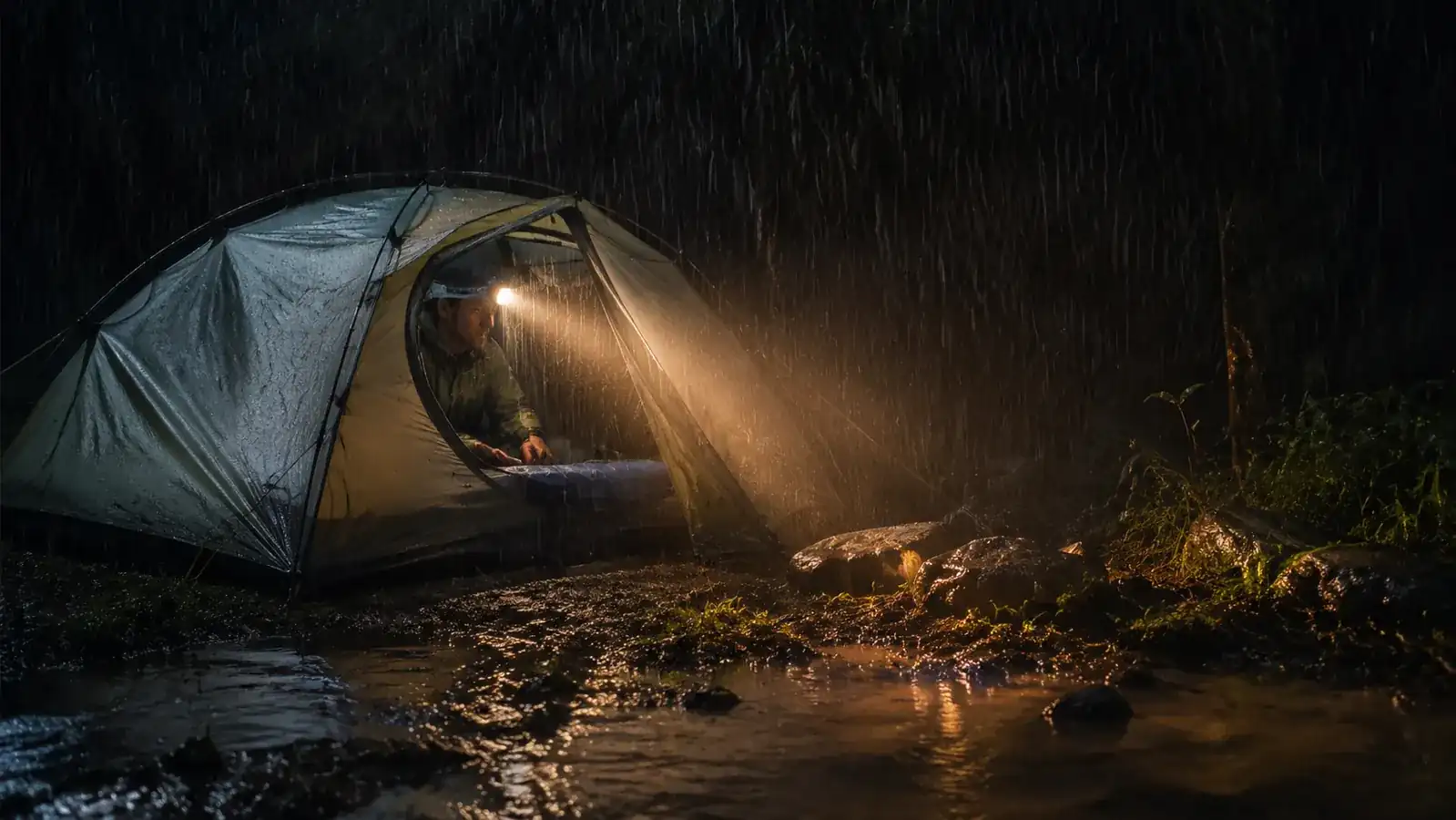
Here's what I actually care about in a tent: does it keep me dry when it matters? On that metric, the CORE dome performed better than I expected for the price. The 1200mm HH (hydrostatic head) rainfly is the minimum I'd accept for serious camping, and it held up in both moderate steady rain and the burst thunderstorm in Vermont. The floor is bathtub-style with welded seams, which matters more than most buyers realize. Water doesn't just fall from above -- it pools on the ground and wicks under tent floors that aren't sealed properly. The CORE's bathtub floor kept every drop out. I saw no floor leakage in any of my trips.
The guy-out points on the rainfly are a genuine strength. There are multiple loops around the perimeter, enough that you can tension the fly tightly and keep it from flapping in moderate wind. A loose rainfly is a noisy rainfly, and after three trips of getting this right I can set the tension in about four minutes. The cord tensioners are basic but functional -- they hold position without slipping through the night.
Wind is where it gets conditional. Freestanding dome geometry is inherently more stable than A-frame or cabin designs. The CORE uses two crossing poles plus a short ridge pole, which is a solid architecture for a budget tent. But the pole material, fiberglass, is the limiting factor. Aluminum poles deform under load and spring back. Fiberglass poles under serious stress can crack at the ferrule connection points. I haven't cracked mine yet, but I also don't push it above 35 mph. If you're a four-season camper or do any exposed high-country camping, step up to a tent with aluminum poles. That's not a knock on the CORE -- it's just an honest assessment of the physics.
Ventilation: Good in Theory, Needs Active Management
The CORE has mesh panels on the door and rear wall, plus a ceiling vent on the rainfly. In theory this creates excellent cross-ventilation. In practice, during cold mornings below 40 degrees, you'll want to close the ceiling vent or you'll be sleeping in your own condensation. On my solo Adirondacks trip in mid-September, I woke up two mornings in a row with visible moisture on the inside of the rainfly because I'd left the ceiling vent cracked. I closed it on night three and the condensation dropped significantly. The lesson: treat the ceiling vent as a summer feature, not a default-open setting.
In warm weather, the opposite is true: the mesh door and rear panel create real airflow when both are opened, and the tent stays comfortable through 80-degree nights as long as there's any breeze. It's a genuinely good warm-weather tent. The two-door design also means two people can get in and out without crawling over each other, which sounds trivial until you're gearing up for a pre-dawn hunt.
One feature I use constantly: the gear loft pocket and the corner pockets inside the tent. Headlamp, phone, knife, small first-aid kit -- I hang the loft pocket over my head every night and everything's exactly where I need it in the dark. Small detail, but it's the kind of thing you miss immediately when you switch to a cheaper tent that doesn't have it. After three nights of fumbling for a headlamp at 4:30 am before installing the loft, I now consider it non-negotiable.
Durability Check After a Year of Real Use
After five trips, here's the condition report. The rainfly fabric is holding up with no visible UV degradation or tears. The zipper pulls on the door are smooth, which is not guaranteed on a budget tent -- a gummy or snagging door zipper is one of the most common failure points I've seen on cheaper shelters, especially after exposure to dirt, pine sap, and repeated wet-dry cycles. The pole ferrules, the metal sleeves where poles connect, are tight without being difficult to assemble. The only visible wear is on the pole fabric sleeves, which show light fraying at the ends from repeated assembly. Not structural, but worth watching after another season.
The floor material is the part I'm watching most closely. Polyethylene floors on budget tents tend to wear thin on rocky or abrasive surfaces, and then they crack along ground-contact points. I've been using a thin foam footprint under mine on rocky sites. It adds half a pound and probably doubles the floor's useful lifespan. I'd call that a worthwhile trade. If you camp on soft forest floor or sandy sites consistently, the footprint is optional. On gravel or shale, I wouldn't skip it.
What I Liked
- Bathtub-style welded floor keeps water out in real rain -- no leakage across five separate trips
- 1200mm HH rainfly handles steady moderate rain and survived a direct thunderstorm overnight
- Interior organization (gear loft, corner pockets) is genuinely useful in the field at 4 am
- Freestanding dome assembly is repeatable and gets fast with practice -- 12 minutes solo by trip three
- Two-door design lets two people get up and move without crawling over each other
- Packed size is manageable for a 4-6 person tent -- fits in a car trunk or lashes to a 55L pack
Where It Falls Short
- Included wire stakes are nearly useless -- bend or snap on any ground harder than soft dirt
- Rainfly gap above main door allows driven rain into the mesh vent panel if door faces windward
- Fiberglass poles flex noticeably above 35 mph and are not suited to exposed high-wind terrain
- Stuff sack is too small and lacks compression -- rainfly requires precise folding to fit
- Condensation management requires active ceiling vent adjustment in cold weather below 40 degrees
How It Compares to What I've Used Before
My previous tent was a Coleman Sundome 6-person, which I used for four years of hard use before the floor seam gave out. If you want the full head-to-head between these two, the CORE dome tent vs Coleman Sundome comparison breaks it down in detail. The short version: the CORE has better interior organization and a more weatherproof floor; the Coleman has slightly stiffer poles and a better carry bag. They're in the same class, priced very similarly most of the time, and both are legitimate picks for 3-season car camping.
What I can say after a year with the CORE is that I have no plans to go back to the Coleman. The gear loft alone keeps me here. When you're at hunting camp at 5 am trying to find your headlamp without waking your partner, that pocket pays for itself in the first trip. And the bathtub floor construction on the CORE feels more confidence-inspiring than the Coleman's flat-seam floor -- though to be fair, the Coleman held up for four years before it failed, which is respectable for a budget tent.
Who This Is For
The CORE dome tent is the right call if you camp 3-15 nights a year in 3-season conditions, in forested or sheltered sites, with two to four people. Car campers, hunting base camp setups in the trees, family weekend trips, trail-adjacent car-camping. It's also fine for solo hikers who want more interior space and don't mind the weight -- it packs to about the size of a large water bottle rolled inside its own bag, and I carried it inside my Teton 55L on the Adirondack solo without issue, though it did take up a meaningful chunk of that pack's volume.
If you're doing anything above treeline, in sustained coastal wind, or in exposed alpine terrain, you need a four-season tent or at minimum a tent with aluminum poles and a geodesic design. This isn't that tent. Know your use case and it's a genuinely good value for what it is: a capable, waterproof, well-organized 3-season dome at a price that doesn't hurt.
Who Should Skip It
If you camp above treeline or in exposed high-wind terrain, skip this tent and look at something with aluminum poles and a geodesic pole structure. If you want a true four-season shelter for late fall deer camp with hard freezes, look at double-wall alpine tents where the inner wall and rainfly work as a system against condensation. If you need something that packs down small enough for a multi-day backpacking trip where weight is the primary constraint, the CORE is too heavy at around 9 lbs. And if you're not willing to buy a set of proper aluminum stakes before your first trip, prepare to be frustrated on night one.
This is a 3-season tent priced honestly for what it is. Treat it like one, site it well, bring your own stakes, and orient the door downwind. Do those four things and it'll hold up for years of real camping. Push it into conditions it wasn't designed for and you'll end up writing a one-star review that isn't really the tent's fault.
Budget-friendly for a tent that's kept me dry through five real trips, including one surprise thunderstorm.
The CORE Dome Tent is competitively priced right now on Amazon with Prime shipping. That's a legitimate value for a freestanding 4-6 person dome with a proper bathtub floor, gear loft pockets, and a separate rainfly included. Just budget for better stakes before trip one -- and check the current price, it moves.
Amazon Check Today's Price on Amazon →