
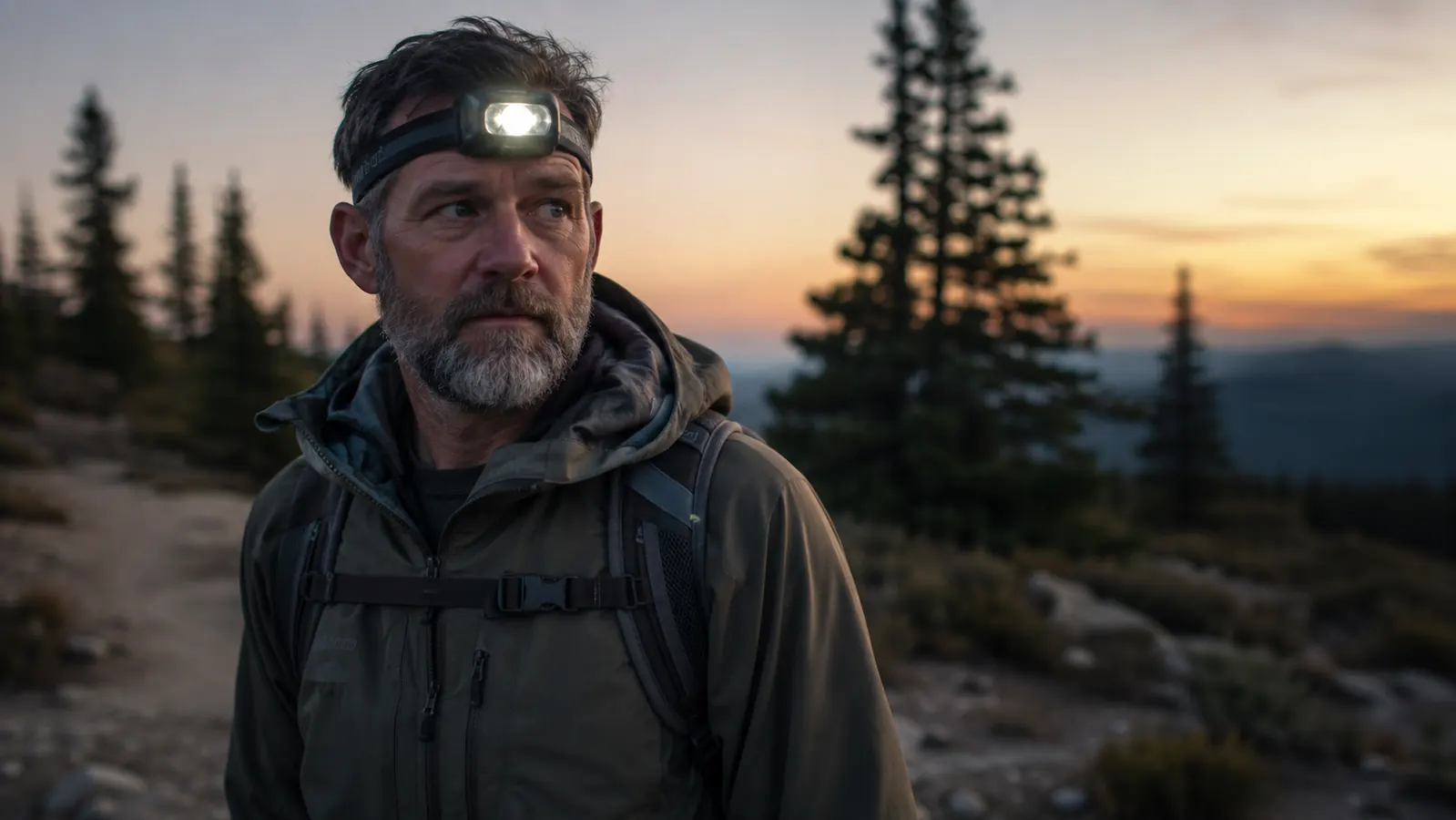
Last October I was fishing the Sierras with my buddy Dale, and his battery-powered headlamp died around 2am. He had a single spare AA that bought him maybe 40 minutes of dim light. I've been in that situation enough times that I switched to rechargeable headlamps three seasons ago and never went back. The Blukar 2000-lumen rechargeable LED headlamp is what I've been running this past full season, from predawn deer setups in October through summer fishing trips and three nights of backpacking in the Trinity Alps. It's a budget headlamp. I'll tell you exactly what that buys you.
More than 20,000 people have bought this lamp on Amazon, and a 4.5-star rating at that volume usually means something real. It also means there's enough feedback out in the wild to know what breaks and what doesn't. I've been paying attention to both.
The Quick Verdict
A legitimately bright rechargeable headlamp at a price that makes it easy to keep a spare. Battery life on high is short and the strap loosens over long nights, but for camp chores, hiking, and hunting setups, it earns its spot in the kit bag.
Amazon Check Today's Price →If your current headlamp runs on AA batteries, this is what a budget upgrade actually looks like.
The Blukar 2000L rechargeable headlamp is one of the top-selling camp lights on Amazon for a reason. Check current availability and pricing before your next trip.
Amazon Check Today's Price on Amazon →How I've Used It
I got this lamp in late August and started running it immediately. First real test was a solo backpacking trip in the Trinity Alps, three nights out. I used it for everything: breaking down camp before dawn, navigating a creek crossing at 10pm when I came back from fishing later than planned, finding gear in the tent at midnight, and cooking dinner in the dark because I misjudged how fast the light drops after 7pm at altitude.
After that I ran it through bow season and rifle season, mostly as my standard truck-to-stand light. I wear it on my hat brim rather than directly on my head since it sits steadier and doesn't shift when I look down at my footing. I've also used it at two car camping sites for general camp chores, and on a couple of night fishing runs on the Feather River where hands-free light matters more than almost anything else.
So it's not a one-trip review. I've put maybe 60 to 70 hours of runtime on this thing across different conditions: cold dry air in October, damp fog near the coast, summer heat at elevation. That gives me a reasonable read on what holds up.
Brightness and Beam: What 2000 Lumens Actually Means in the Field
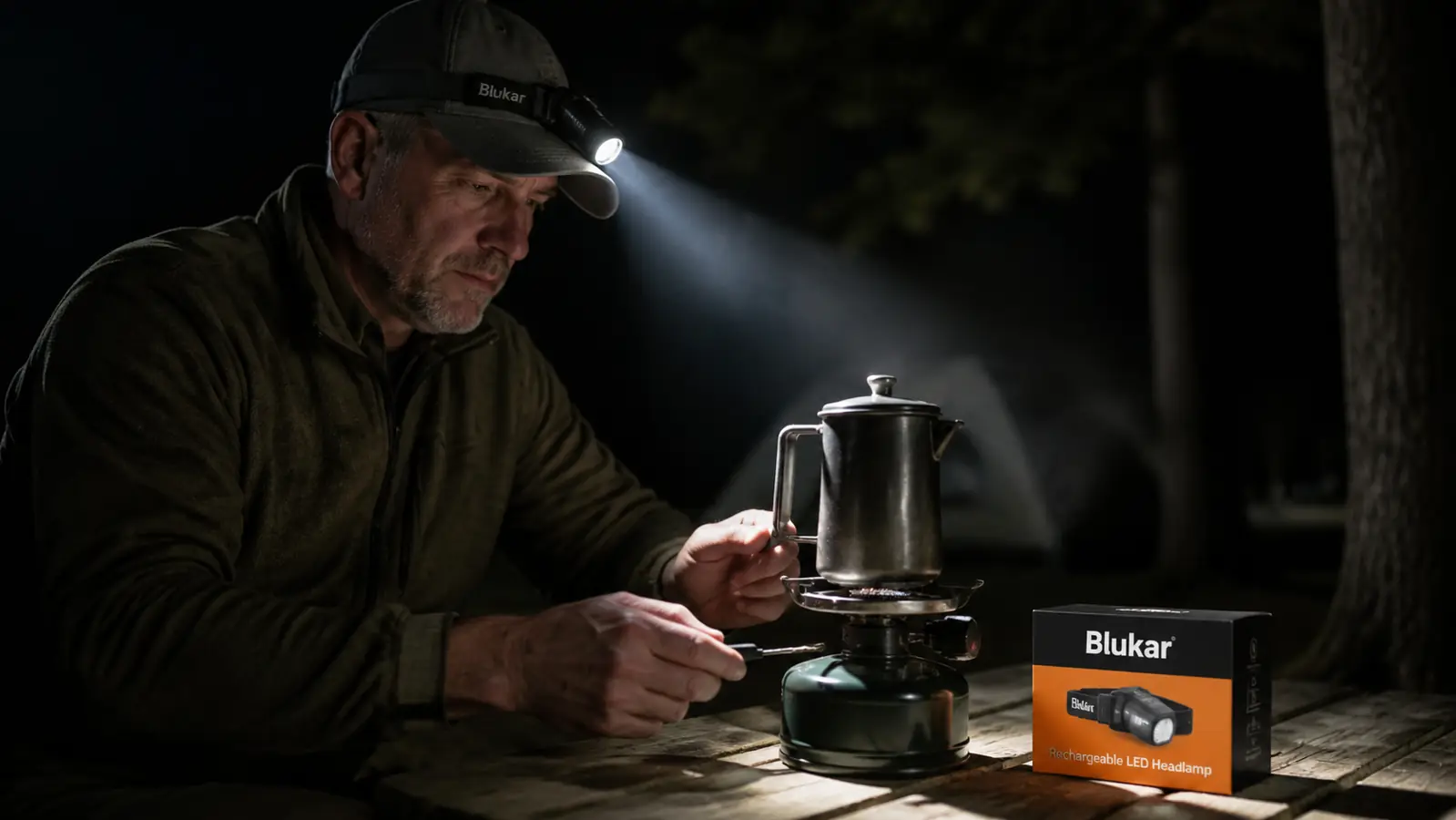
Let me calibrate expectations first. The 2000-lumen claim is a peak burst number on the highest setting. In sustained use, you're probably getting something closer to 800 to 1200 lumens of usable light before the lamp steps down to protect the battery. But even at that real-world output, this headlamp is dramatically brighter than any battery headlamp I've used at the same price point. On a trail at midnight, the high beam reaches out 50 to 60 feet and lights the ground clearly enough to pick footing on uneven terrain. On medium, which is what I use for most camp work, the beam is focused and plenty bright for tasks within 15 feet.
The lamp has a wide-beam and a spot mode, which you cycle through by pressing the side button. Wide flood mode is what I want for camp chores, cooking, and reading a map. Spot mode is what I reach for when I'm moving through trees and want distance. That toggle is genuinely useful in the field, not just a spec-sheet feature.
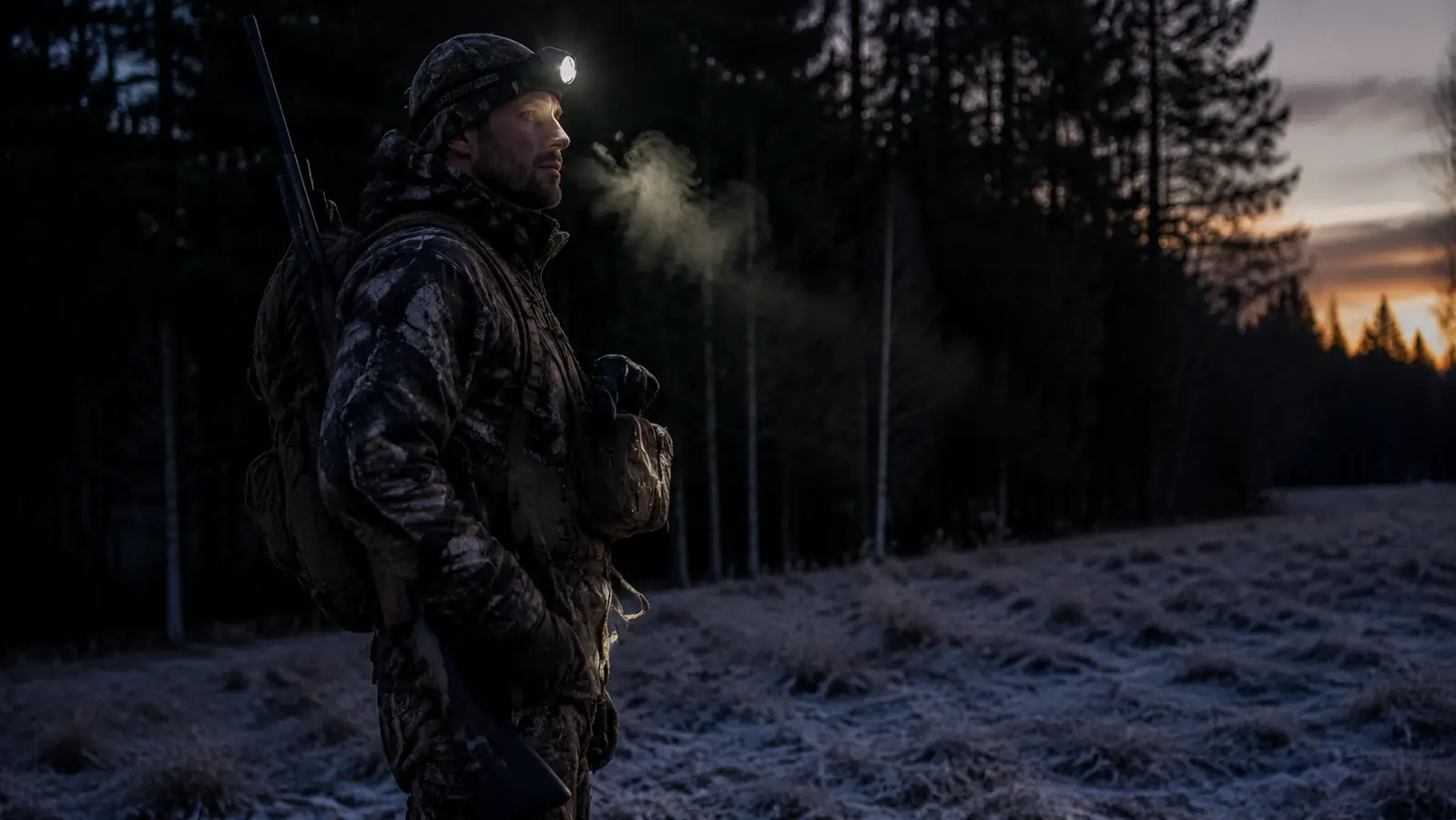
There's also a red light mode. I use it around camp at night when I don't want to kill everyone else's night vision, and I use it for deer hunting situations where white light would spook game before legal shooting light. It's a dim red, not a high-output red, but it works for what it's for.
On the high beam at midnight, the Blukar lights trail footing out to 50 or 60 feet. For a budget lamp, that's not a gimmick. That's genuinely useful in the field.
Battery Life: The Honest Numbers
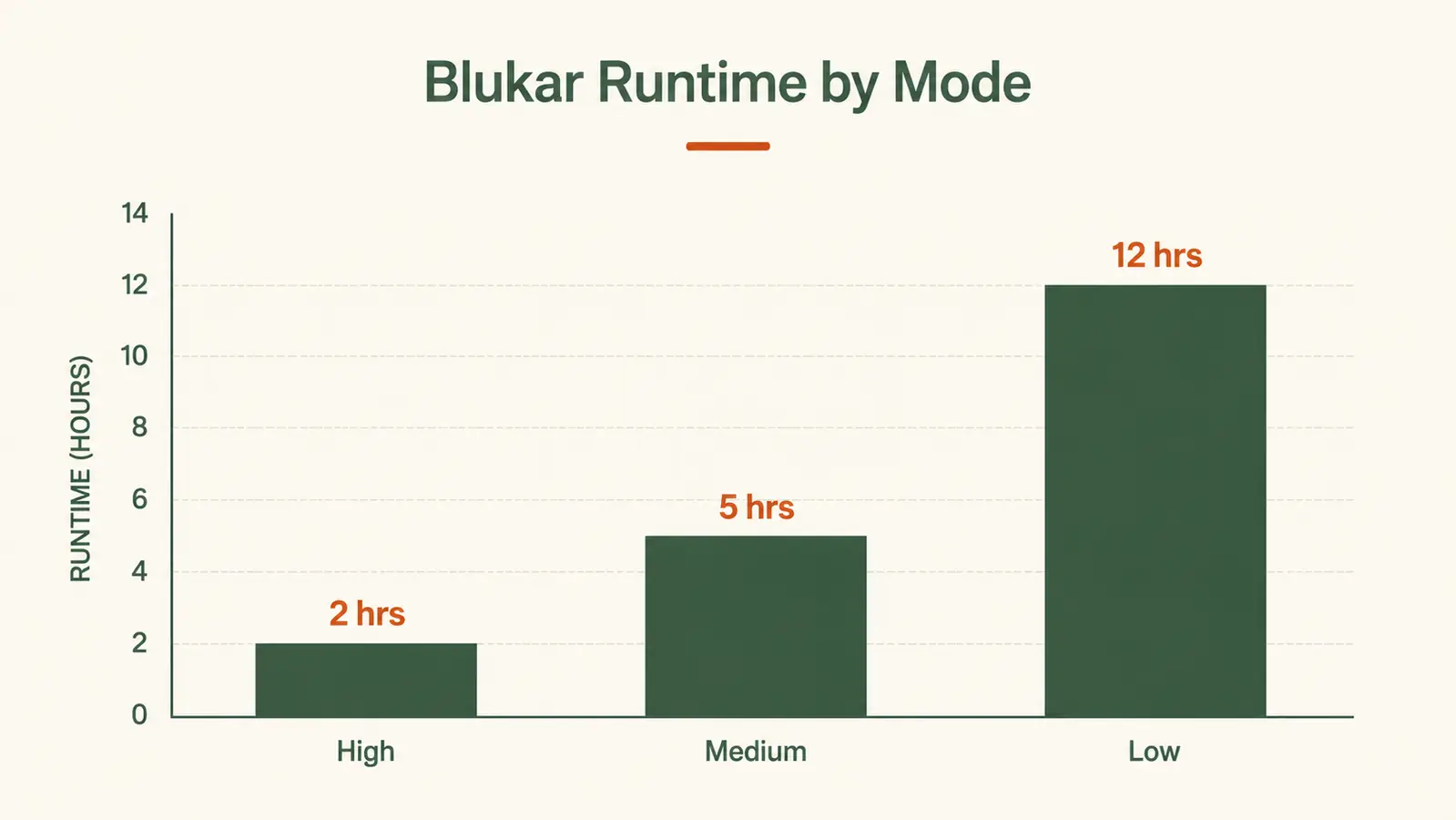
This is where I need to be straight with you. On high beam, I get roughly two hours before the lamp starts stepping down noticeably. For a predawn hunting setup where I'm moving for 45 minutes in the dark and then sitting, that's totally workable. For a full night backpacking where the lamp is on and off for six hours, high beam is not your friend. You have to be strategic.
On medium, I'm getting around four to five hours. On low, I've run it for ten or twelve hours without issue. The motion sensor mode, where the lamp turns on when it detects your hand wave, extends battery life significantly because it's not running continuously. I use this mode at camp when I'm going in and out of the tent and don't want to leave the light burning the whole time. It's one of the better practical features on this lamp.
Charging is via USB-C, which is the right call. I carry a small USB-C power bank in my kit anyway, so topping off the Blukar in camp is easy. A full charge takes about two hours. I will say the charge indicator is a bit vague: one solid light for charged, blinking for charging, but you don't get a percentage or multi-stage indicator. I've been caught a couple of times thinking it was fully charged when it still had 20 minutes to go. Not a dealbreaker, but pay attention to the charging time rather than just watching the indicator.
Build Quality and Fit Over a Full Season
The housing is plastic but it's a dense, solid-feeling plastic, not the rattly cheap kind. The lamp head tilts up and down smoothly and holds its angle under load. I've had cheaper headlamps where the tilt mechanism loses tension and the head droops down after a few months. The Blukar hasn't done that yet after a full season.
The strap is where I have the main complaint. It's elastic and comfortable at the start of a night, but on multi-hour sessions the elastic stretches and the lamp gradually migrates down my forehead if I'm moving around a lot. I've taken to using a safety pin to cinch the strap tighter after the first adjustment. It's a two-minute fix but you shouldn't need to do it. The strap could be stiffer without sacrificing comfort and that would fix the issue entirely.
Water resistance: the spec claims IPX4, which is splash-resistant from any direction. I've worn this in light rain twice and it worked fine both times. I haven't submerged it and wouldn't bet my life on it in a full downpour, but for the conditions most campers and hunters actually encounter, it handles moisture without issue. I also want to mention the motion sensor on the front. It works reliably in my experience, and the range is forgiving enough that a hand wave six to eight inches from the lamp triggers it consistently. Some reviewers have complained about false triggers in brush. I haven't had that problem, but I also don't run the motion sensor when I'm moving through heavy cover.
How It Compares to What I Was Using Before
Before the Blukar I was using a name-brand headlamp that runs on AAA batteries and costs more. The beam on the Blukar is noticeably brighter, no contest. The shift to rechargeable means I stopped buying batteries for my headlamp, which adds up over a season of regular use. The one thing the battery-powered lamp had going for it was field serviceability. If the battery died in a remote spot, I could buy replacement AAAs at any gas station. With the Blukar, if the internal battery dies and I have no USB-C power source, I'm done. That's the real tradeoff with rechargeable: you gain convenience in normal conditions and lose flexibility in genuine emergency situations.
For those who want to dig further into the comparison between the Blukar and a higher-end rechargeable option, I wrote a full breakdown in my Blukar vs Petzl Actik Core comparison. Short version: the Petzl is better, and it costs five times as much. Whether that gap is worth it depends on how you use a headlamp.
What I Liked
- Genuinely bright for the price, high mode lights trail footing at 50-plus feet
- USB-C rechargeable, works with the same power bank you already carry
- Motion sensor mode is useful and extends battery life at camp
- Flood and spot beam modes are both practical, not just spec-sheet padding
- Red light mode works for camp courtesy and hunting low-light situations
- Tilt mechanism holds its angle after a full season of use
Where It Falls Short
- High-mode runtime is around two hours, not enough for extended use without a recharge
- Elastic strap loosens and migrates over long nights of active movement
- Charge indicator is vague, no multi-stage percentage display
- No field-replaceable battery, so a dead charge in the backcountry with no USB-C source means no light
The Motion Sensor: Useful Gimmick or Actual Feature?
I was skeptical of this when I first got the lamp. Motion sensors on headlamps sound like marketing noise. But I've come around on it. Here's the specific situation where it earns its place: you're in the tent in the dark, rummaging through your bag for something. You need quick light, then want it off again so you can sleep. Waving your hand at the lamp sensor is faster and less disruptive than finding the button and pressing it, especially when your hands are cold or you're wearing gloves. I use it at camp more than I expected to.
I wouldn't make it my primary mode while hiking because of the potential for false triggers, and the turn-on delay is about half a second, which is just long enough to be mildly annoying when you're doing fast repetitive tasks. But as a camp-convenience feature, it's genuinely useful. The fact that it saves battery life is a bonus.
Who This Is For
The Blukar makes the most sense for campers and hunters who use a headlamp regularly but don't depend on it as their primary safety tool in serious backcountry situations. If your typical night is a campground, a car camping setup, a fishing trip where you're back before full dark most of the time but want reliable light for the exceptions, or a hunting morning where you're covering a mile of familiar trail to your stand, this lamp handles all of that well and the price means you can buy a second one to keep in your truck without thinking twice about it. I'd also recommend it if you want to stop buying batteries. The math shifts quickly once you're camping four or five weekends a year.
If you want to understand how to get the most out of a lamp like this on different campsite setups and night hike situations, the campsite lighting guide walks through the practical scenarios where beam modes and battery management matter most.
Who Should Skip It
If you're running solo multi-day trips in genuinely remote terrain where a light failure has real consequences, the Blukar's sealed internal battery is a liability. For that use case you want either a headlamp that takes standard replaceable batteries, a high-quality rechargeable with a proven multi-season track record and a longer warranty, or ideally both. The Blukar is a great value but it doesn't belong in a survival kit where reliability margin really matters. Same logic applies if you're doing extended overnight cave exploration, technical canyoneering, or any situation where the light going out creates a serious problem rather than an inconvenience.
It's also probably not the right pick for a runner doing ultramarathons or trail races where the headlamp is on for four or more hours straight on high mode. Two-hour high-beam life isn't enough for that use case. For everyone else, it covers the ground. If you're still on the fence about whether to switch from a lantern or battery-powered light to a rechargeable headlamp setup, the breakdown on rechargeable headlamps vs battery lanterns walks through the tradeoffs in detail.
A solid rechargeable headlamp that earns its keep on the trail and around camp, at a budget-friendly price.
The Blukar 2000L has 20,000-plus verified buyers on Amazon and a 4.5-star rating. Check today's price and availability before your next trip.
Amazon Check Today's Price on Amazon →